The Rise of the Tourism Industry, 1953 – 1972
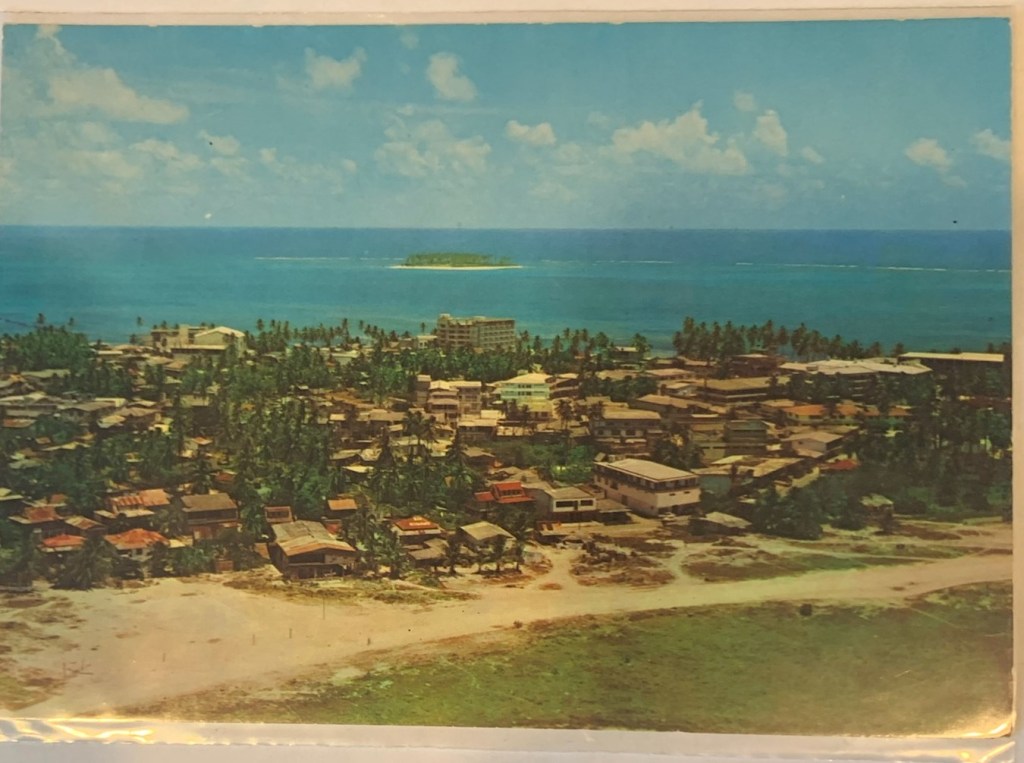
On 13 November 1953, Lt. General Gustavo Rojas Pinilla was the first Colombian president to visit the Archipelago of San Andrés and Providencia. Three months earlier, Rojas Pinilla, supported by the Colombian military and elite members of the Liberal and Conservative Parties, overthrew President Laureano Gómez to end a period of unprecedented partisan bloodshed on the mainland known as La Violencia. His goal was to achieve peace and further develop the nation. As part of his efforts to introduce himself to Colombians, Rojas Pinilla conducted a national tour visiting strategic and neglected areas of the country. Arriving with his entourage, which included senior military officers and Colombian and international correspondents on three amphibious Catalina planes from Avianca Airlines and the Colombian Armed Forces, they managed to land safely at 11 in the morning despite flying through a storm.
Newspapers reported the jubilation of the island residents. Rojas Pinilla found islanders waving handkerchiefs and flags, dancing in the streets, and shouting, “Viva Colombia!” They placed postcards with Rojas Pinilla’s slogan ‘for the homeland, peace, and justice” on their home windows or lifted high in their hands. These ebullient scenes, unlike any witnessed in other places along the tour at that point, moved one reporter to describe “some strange emotion that we have experienced to see our distant compatriots feel the homeland in all its forms, their Colombian hearts vibrate with joy and pour tears of happiness before the first president in whose person they see the entire country.”[1]
Local school children, some marines, and the newly appointed governor, Intendant Maximiliano Rodríguez, officially greeted Rojas Pinilla and his entourage. After Rodríguez made his introductions, the Colombian president delivered a speech broadcast on the radio. It was the first time mainland Colombian listeners heard a national broadcast directly from San Andrés Island. The attendees applauded and shouted in Spanish and English at his promises of bringing progress to the island. These promises were part of an ongoing project of Colombian integration of the archipelago. Rojas Pinilla put it like this:
“With true pleasure, I bring you affection from the mother continent,
and I greet you with emotion as Head of State and the Supreme
Commandant of the Armed Forces of our homeland. It is a
pride for the military that one of them has been the first, as president
of the nation, to come to these islands, as Colombian as the national
capital, however, they remained for many years hidden and
helpless, as if treated like grandparents’ old forgotten treasure
and reconquered for the glory and welfare of its descendants. You
have all been faithfully united to the homeland by an invisible thread
of our faith and a favorable and silent worship of its glories. You have
long hoped that someday the arms of Colombia would arrive at your
beaches with effective help and protection to incorporate them
with words of encouragement to the general progress of the nation.”[2]
To hear Rojas Pinilla deliver the above lines and a bit more in Spanish, please listen to the following clip below.
The above clip came from Radio Nacional de Colombia’s Podcast Historias Onda Larga where you can listen to an excellent 40-minute episode here.
Rojas Pinilla used his visit to engage various stakeholders on the island. After delivering his speech, someone translated it into English sometime later to allow islanders, the majority of whom spoke little to no Spanish, an opportunity to learn more about the purpose of his visit. Before he departed two days later to visit Cartagena and Montería on the Caribbean coast, Rojas Pinilla swam in the Caribbean Sea, chatted with islanders, pardoned a common criminal, and issued a series of decrees, apportioning funds to spur on his recovery of this forgotten, faraway portion of Colombia. He allocated money to open a local bank and extended credit to open a copra factory, which could process coconuts and turn them into vegetable oil and butter to restart the decimated coconut industry. Rojas Pinilla promised to build a powerful radio station in San Andrés to improve communications. Lastly, he declared that San Andrés would become a free port in Decree 2966 bis of 1953.
Although San Andrés Island did not officially become a free port until the Colombian Congress passed Law 137 of 1959 (21 of December) under President Alberto Lleras Camargo, who succeeded Rojas Pinilla in 1958 as the first president of the bipartisan National Front, work did begin in the months and years after his visit.[2]Intendant Maximiliano Rodríguez was responsible for jumpstarting the infrastructure projects to build roads, a hotel, and, most importantly, an airport. To accomplish these tasks, he first needed land, which was held nearly entirely by the local island population. The government enacted eminent domain and confiscation of public lands (baldíos) with compensation to its owners. Rodríguez focused on the sector of the North End where public officials like him and a few other merchants lived. It was sparsely settled, with a few residences, a government building, and several shops. It was a suitable place to build an airport and further development.
Despite resistance to the bullying tactics of acquiring land from islanders, many islanders initially felt excited about the new changes. Road projects. New buildings. Airplane travel. Whether people visited for the cheap merchandise, beautiful beaches, or the combination of the two, affluent and rising middle classes of mainland Colombia and nearby Central America poured onto the island. By March 1960, 46,000 visitors had traveled to San Andrés, while another 7,000 had arrived before the end of that year.[3] These numbers steadily rose over the next decade. Their presence prompted enterprising island families with capital to open businesses such as restaurants, small hotels, and recreational activities to meet the demand of tourists. But, not all islanders benefitted from the changes brought on by the free port and tourism.
Table: San Andrés Island Census, 1793 – 1973
| Year | San Andrés Island |
| 1793 | 393 |
| 1835 | 644 |
| 1843 | 731 |
| 1851 | 1,275 |
| 1870 | 3,530 includes Providencia |
| 1912 | 3,124 |
| 1918 | 3,653 |
| 1938 | 4,261 |
| 1951 | 3,705 |
| 1964 | 14,413 |
| 1973 | 20,39 |
Source: Adolfo Meisel Roca, “La continentalización de la isla de San Andrés: panyas, raizales y turismo, 1953 a 2003,” Revista del Banco de la República 76:913 (2003): 19.
Launching public works projects, hotel constructions, tourist services, and open duty-free shops required labor. San Andrés islanders became disadvantaged in several ways. First, many island adults spoke little Spanish and had to compete with the laboring classes who migrated from the coastal cities around Barranquilla and Cartagena. These new arrivals shared the same language and culture as many new merchants starting business in North End. Moreover, owners built their hotels and shops with cement blocks; islanders had traditionally built their homes and buildings with wood. Discrimination in the labor market also played a role. There were incidents where islanders were fired and replaced with recent arrivals.[5]
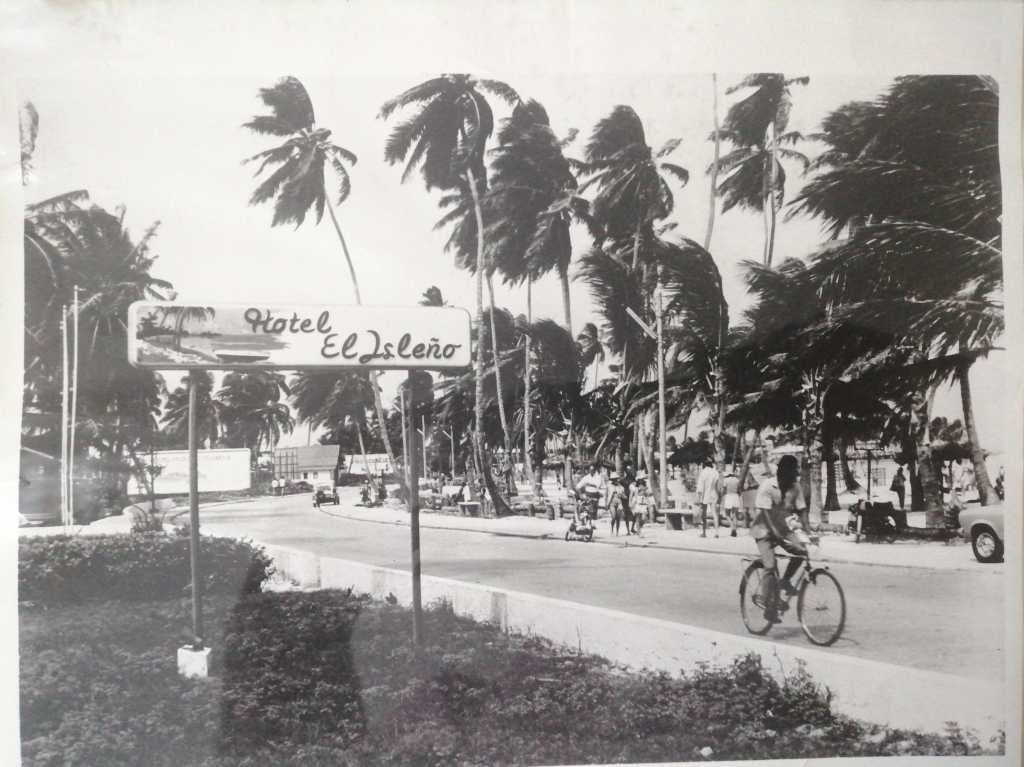
Within a few short years, many islanders became disillusioned with the promise of the free port and tourism industry. Their frustration over the state of the archipelago included issues such as land dispossession and overpopulation due to migration from mainland Colombia to the island, which prompted calls again for greater administrative autonomy or even separation from Colombia. By 1972, Colombian authorities adjusted the administrative system to regulate the free port and tourist economy and respond to growing island resentment. The next decades would find the free port and tourism economies linked to another aspect of mainland Colombia: narcotrafficking.
[1] “Los isleños hacen gran recepción Gral. Rojas Pinilla,” El Tiempo, Bogotá, November 13, 1953.
[2] See a fuller discussion of Lleras Camargo’s second term as president in Robert Karl’s Forgotten Peace: Reform, Violence, and the Making of Contemporary Colombia (Berkeley: University of California Press, 2017), 15-37.
[3] “46,000 personas viajaron el año pasado a San Andrés,” El Tiempo,March 23, 1961, 17.
[4] Thomas J. Price, “Algunos aspectos de estabilidad y desorganización cultural en una comunidad isleña del Caribe Colombiano,” Revista Colombiana de Antropología Vol. 3 (1954): 19.
[5] Price, “Algunos aspectos de estabilidad,”39. For accounts on San Andrés islanders’ experiences at Catholic schools in the 1960s, see Fidel Corpus Súarez, “Sentémonos a escribir juntos la historia” and Yasmine Dau, “El lamento sustituye afán de pensar el futuro,” in Textos y testimonios del archipiélago: crisis y convivencia en un territorio insular (San Andrés Isla, Col: Universidad Nacional de Colombia Sede San Andrés, 2002), 63; 68.
 theraizalpeople