The Collapse of the Coconut Industry, 1908 – 1930

By 1932, San Andrés islanders confronted the unthinkable: their once robust coconut trade had finally collapsed. Alfonso Rincón, the latest in a string of Bogota-appointed intendants since 1913, informed the minister of government that not a single schooner had visited as they did previously, stopping there every two months to purchase coconuts and then delivering them to various U.S ports. [1] The loss of the coconut trade –as the single source of wealth—coupled with the effects of the global economic depression triggered poverty for many. San Andrés islanders experienced a similar boom and bust pattern as other agro-export-dependent economies across the Caribbean.
The early history of coconut cultivation on San Andrés Island is murky. Before the middle of the nineteenth century, San Andrés landowners deployed their enslaved laborers to grow cotton for export, though never an enormous producer for the global market. One story credits a Colombian government official named Antonio Escalona for introducing it to islanders as a new crop after he arrived in the 1820s. Another account credits a devastating hurricane that destroyed the cotton harvest on the eve of slave emancipation as the cause for such a change. Raizal author Hazel Robinson Abrahams fictionalized this version in her award-winning 2002 book No Give Up, Maan, No te Rindas! She imagines the ingenuity of a single slaveholder to plant coconut seeds acquired from the San Blas Islands, situated between present-day Panama and Colombia, in the aftermath of the hurricane. Robinson infuses an imaginative flare in her retelling of an island lore. Both accounts may likely be true. Escalona or another government official brought coconut seeds. Landowners experimented with it as a new export crop as cotton prices steadily fell in the middle of the nineteenth century. Simultaneously, coconut oil gained popularity as a new vegetable oil in European and U.S. markets.
The shift to coconut cultivation coincided with the end of slavery, as initially enslaved and later emancipated people dominated the trade. By 1841, it was common for four to five ships to pass through San Andrés to pick up thousands of coconuts. Writing to the U.S. State Department in 1873, Philip Beekman Livingston, the U.S. Vice Commercial Agent and leading abolitionist in San Andrés, offers an insightful picture of the coconut trade. He wrote,
“It was about the year 1850 that attention of five or six slave holders was turned to planting coconut before the emancipation of their slaves, they had secured large coconut groves which is now the support of their offspring in easy circumstances, who would otherwise be destitute. The emancipation came off in the year 1853. Thrift was soon manifested among the emancipated part of the population, lands were purchased and cleared, the timbers felled, and coconut planted and by the time 1856 had downed upon San Andres it had become a coconut country. American vessels had become regular traders and the former slave the present principal controller of commerce.”
Livingston explained how the price of coconut rose from ten to 25 dollars per thousand coconuts brought economic prosperity to the freed population.“ The controllers of the commerce of this Island are principally those who used to be slaves or their posterity, their houses are now all shingled, boarded round and painted, much nicer and more expensive than their owners houses were. Money is plentiful.”[2]
A Leslie Popular Monthly reporter visited San Andrés around the same time as Livingston sent his report and called it “the greatest cocoanut-producing island in the Caribbean, and from it, almost all American fruit merchants, engross, draw the greater part of their supplies of fruit.”[3]
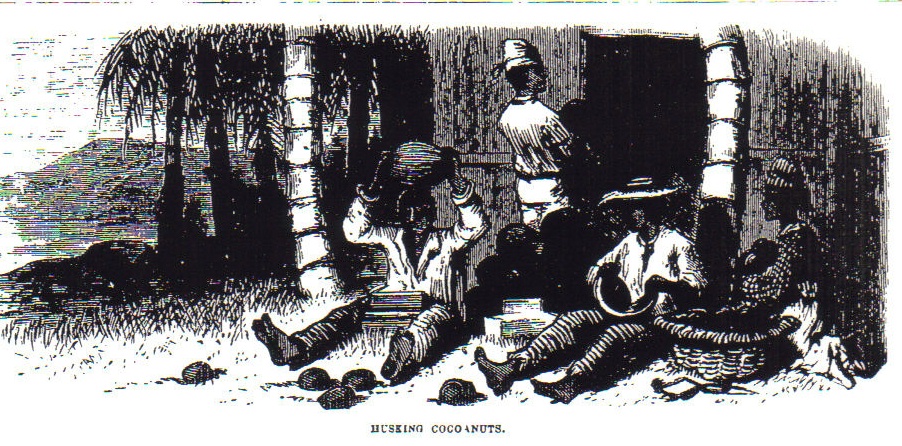
Alfred Tremble, “Among the Cocoanuts: A Jaunt through the Island
of St. Andrews,” Leslie’s Popular Monthly, (1877).
Thus, San Andres gained a reputation for its high-quality coconuts, often outcompeting Cuban and San Blas prices. By the 1880s, nearly a hundred British and American ships visited in search of the nut. By 1900, it had consolidated its position as a prime producer of high-quality coconuts with American firms and merchants buying exclusively from the island.
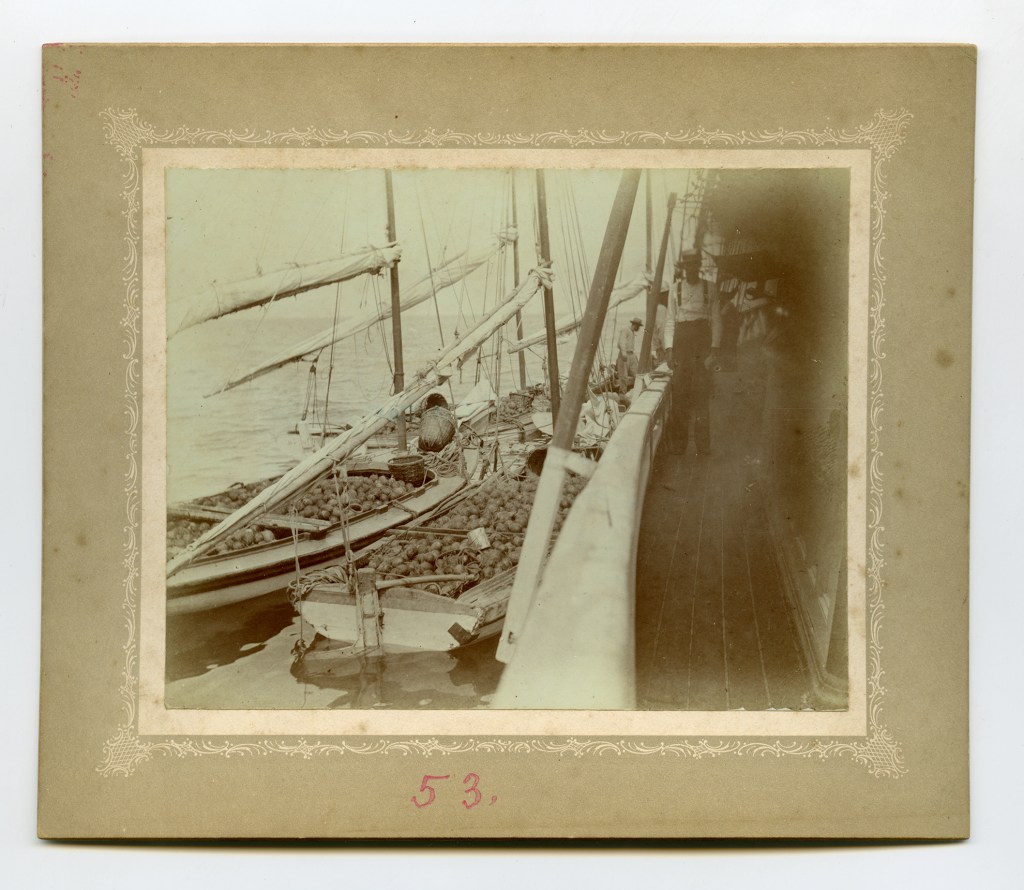
An American sloop picking up coconuts at San Andrés, 1903 (Courtesy of Banco de la República)
The bust of the coconut economy came nearly as quickly as it rose. First, a devastating 1908 hurricane destroyed the island’s coconut groves. San Andrés never regained its desirable position again. Next, the interwar years also saw a lowering in prices as demand slackened and the war impeded safe maritime transport across the Atlantic Ocean. By 1923, reportedly the price for coconuts had plunged to eight dollars. [4] A few years later, an English priest residing on San Andrés observed, “Cocoanuts formerly a good source of revenue, are now practically worth nothing.” [5] Due to the worsening coconut industry, some smallholder coconut growers sold their land with some seeking employment opportunities off the island. The land became increasingly concentrated in the hands of fewer islanders and foreign agro-merchants who took residency, temporarily and permanently in San Andrés. Finally, islander coconut growers’ use of rudimentary planting techniques harmed and eventually degraded the land. First, disease and then rats decimated the coconut trees that had formerly generated wealth for some on the island. By the 1930s, San Andrés islanders witnessed the collapse of their formerly vibrant coconut industry.
In response, some islanders fled to the coasts of South and Central America, such as Panama, in search of work to earn a livelihood. The decline in the island population prompted the government to invite agrotechnicians from mainland Colombia to the United States to investigate the causes of the decrease in coconut production with little success. The heyday of coconut wealth of the former decades never returned to San Andrés again.
[1] Alfonso Rincón to Minister of Government, June 30, 1930, Archivo General de la Nación de Colombia (AGN-C), Ministerio de Gobierno, Sección Primera, Tomo 989, Folio 64.
[2] Philip Beekman Livingston, San Andres, December 31, 1873, US State Department Record Group 59, Despatches from US Consul Officers, Despatches from U.S Consuls in San Andres, Colombia, 1870 – 1878.
[3] Alfred Tremble. “Among the Cocoanuts: A Jaunt through the Island of St. Andrews,” Leslie’s Popular Monthly, Kingston, 1877, p.
[4] Rafael Triana, “Interesante correspondencia de Jimenes Triana sobre el Archipiélago de San Andrés y Providencia,” La Época, 17 February 1923; Carlos M. Hernández to Minister of Government, October 9, 1923, AGN-C, Ministerio de Gobierno, Sección Primera, Tomo 886, Folio 46.
[5] Letter from Fr. Richard Turner to Francis Henry, 26 September 1926, Banco de la República, Centro Cultural, San Andrés Isla.
For more, please read Sharika Crawford, “Under the Colombian Flag: Nation-Building on San Andres and Providencia Islands, 1888 – 1930,” PhD dissertation (University of Pittsburgh, 2009).
 theraizalpeople