Rumors of Secession: San Andrés and Panama, 1903 – 1905

This 1905 cartoon published in The Cleveland Leader, one of the post-Civil War U.S. newspapers, provides an expanded view of the consequences of Panamanian secession from Colombia in 1903, just two years earlier. In this caricature, the artist portrayed the Hay-Bunau-Varilla Treaty between the governments of the United States and Panama, which led to Panama giving a 10-mile strip of land to build an interoceanic canal in exchange for ten million dollars. Since U.S. newspapers covered the canal project in Panama widely, The Cleveland Leader’s readership knew something about the topic. Using racist tropes and imagery of the day, the artist depicted the country of Panama as a Black child, barefoot and dressed in tattered clothes with a straw hat. The child salivated over a large watermelon with $10,000,000 typed across it as it held their hands open ready to receive it. What may have been new to the readership was the visual rendering of two additional Black children, with straw hats that had written “San Andres Island” and “Providence Island” and dressed exactly like the other child representing Panama who stood behind a fence calling out, “You know me Panny” and “Me too Panny.” The image and the caption convey the same message: the Black impoverished islands of San Andrés and Providencia also aspired to join Panama with its newfound wealth from its treaty with the United States. Yet this is neither the correct nor the entire story. While Panamanians successfully launched their secession from Colombia on November 3, 1903, other territories within Colombia took notice. San Andrés Island also had a complicated relationship with faraway authorities on mainland Colombia. In the aftermath of Panamanian secession, islanders also wrestled with the benefits and costs of remaining with Colombia or joining Panama.
San Andrés Islanders had shown displeasure with governance under officials appointed from authorities in Cartagena on the mainland for some time. In the 1870s and 1880s, islanders had one failed assassination and one successful assassination of appointed officials sent to govern the islands. Some sectors of the island community showed a deference for the United States. Likely due to their commercial interests, fantasized about whether the islands could join the United States. Still, they took no steps before the Panamanian secession of 1904. Colombian authorities sent troops to the islands in response to the Panamanian secession, however, surprisingly some of them strongly reconsidered their loyalties.

Just two months after the secession, rumors and then newspapers reported that the Colombian soldiers stationed at San Andrés had abused islanders demanding they pay greater taxes to support their presence on the island. By January 1904, newspapers in Panama and the United States reported the arrival of San Andrés islanders in Bocas del Toro, one island among several a part of a Panamanian archipelago with the same name, revealing the fragility of Colombia’s national integrity. Rumors even circulated that the Colombian garrison had maltreated U.S. merchants in and passing by the island, which prompted calls to send a U.S. gunboat to investigate. While the islander collective memory of this visit coupled with the documentary evidence tells a slightly different story, the U.S. did send a gunboat to investigate rumors of maltreatment of American citizens but also the general political climate for San Andrés islanders. The gunboat returned with a sense that American citizens on the island were treated well and that further investigations with Panama were needed to determine any claim they had to the islands.
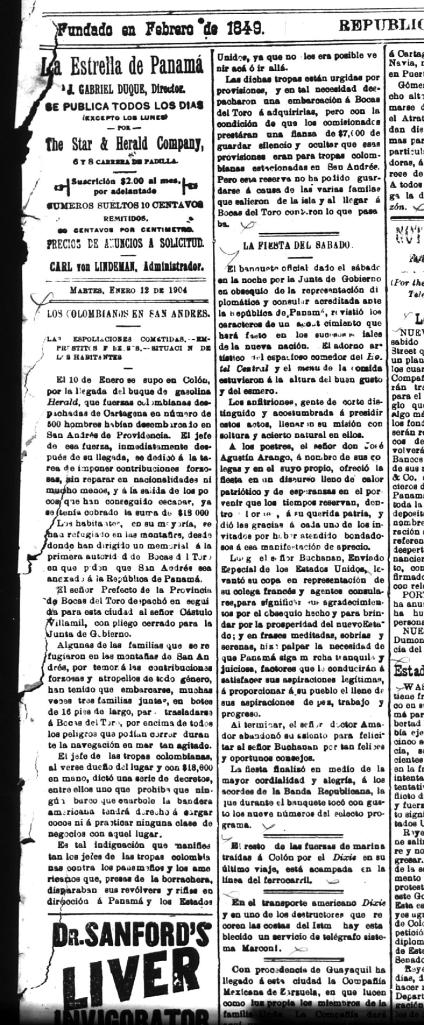
Although the Colombian government had taken military action to secure its claim to the archipelago, this step did not strengthen affection between islanders and the state. This may have been a shared feeling from authorities in Bogota since the Colombian ambassador to the United States engaged in discussions over turning the islands over to the U.S. as possible coaling stations in 1905, the same year The Cleveland Leader published this cartoon. U.S. interest in the islands as a possible coaling station continued until the end of the First World War. In sum, the Panamanian secession and islander sympathies with the secession continued to trigger Colombian authorities in future relations with the islanders.
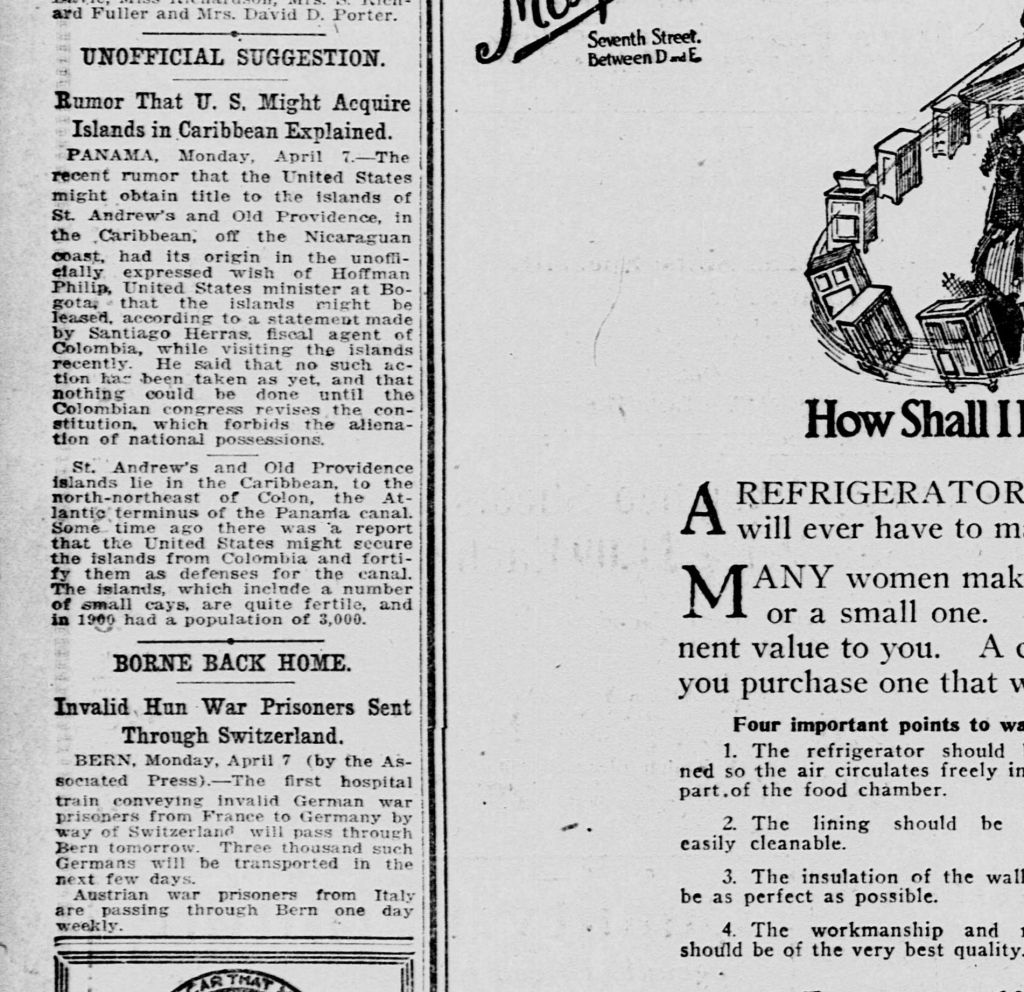
For more on this topic read, Sharika Crawford, “Panama Fever: Colombian Fears of Secession on San Andrés and Providencia Islands, 1903-1913,” The Global South. (Interoceanic Diasporas and the Panama Canal’s Centennial) 6:2: 15-38.
 theraizalpeople