The Creation of the National Intendancy of San Andrés and Providencia, 1910 – 1912

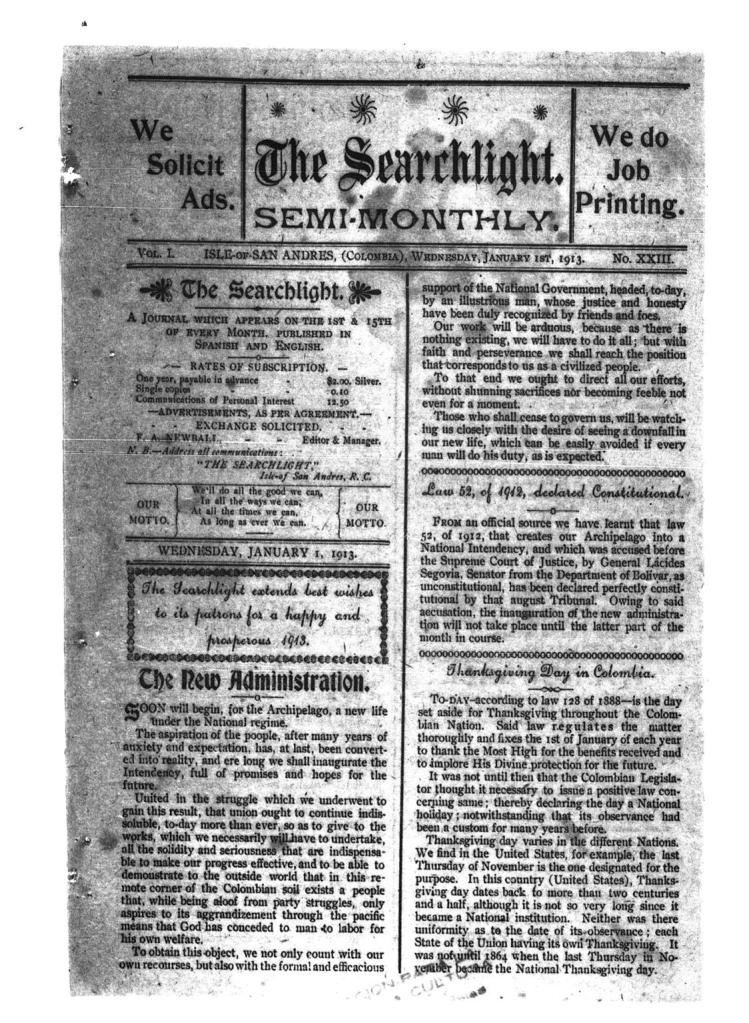
Francis A. Newball, editor and founder of The Searchlight, called El Faro in the Spanish edition, heralded the birth of the National Intendancy of San Andrés and Providencia, a new administrative unit. Writing to islanders in the January 1, 1913 issue, Newball noted how it reflected long-held aspirations for change. “Soon, we will begin, for the Archipelago, a new life under the national regime. The aspiration of the people, after many years of anxiety and expectation, has, at last, been converted into reality, and were long shall inaugurate the Intendancy, full of promises and hopes for the future.” While Newball did not specify the changes islanders anticipated would result from such an administrative change, he acknowledged their role in achieving it.
After Panamanian secession, Colombian authorities intensified their efforts to assert control over their territory, including San Andrés and Providencia Islands. The islands’ location near the Panama Canal, under construction by the U.S.-managed Isthmian Canal Commission, made them valuable to the United States, which continued to show interest in acquiring them. In 1910, the new administration of President Carlos E. Restrepo turned its attention to several frontier territories to integrate them firmly under state control. This project kickstarted on the islands of San Andrés and Providencia when Restrepo sent his nephew Pedro Pablo Restrepo, who led a fact-finding mission. After five months, the young Restrepo submitted a damning report that called out Cartagena-appointed authorities had exploited the islands for years with a handful of officials alongside a small merchant class enjoying privileges. Restrepo advised his uncle to take action. Due to the low regard islanders have Colombian authorities, rumors continuously circulated about the islands becoming annexed to another country, whether it was the United States, Nicaragua, or even an interested Japan.
In 1912, the Restrepo administration called for a census of the islands. A second investigation conducted at this time echoed the young Restrepo’s recommendation to take action to strengthen authority over the islands. Such a call coincided with efforts to reorganize territorial units, which would remove the islands from the governance of the Department of Bolivar, with its capital in Cartagena, to the minister of government in Bogota. Paying close attention to these political discussions, prominent islanders such as Francis A. Newball, for example, saw an opportunity to influence the Restrepo administration and national debates over the governance of the islands. He mobilized islanders and created the islands’ first newspaper, The Searchlight, to stimulate opinion over the potential administrative changes to the island.
After islander petitions, congressional wrangling, and public debates across newspapers in San Andrés, Bogota, and Cartagena, the Congress of Colombia passed legislation to create a new administrative unit: the National Intendancy of San Andrés and Providencia on October 23, 1912. Under this new formation, the Colombian minister of government had the right to appoint an official called an Intendant to govern the islands under the auspices of the ministry of government. Unfortunately, the expectation that close supervision by central authorities in Bogota over the islands meant the end of their concerns about the fragility of state authority over these distant islands of an ethnically distinct population proved too ambitious.
 theraizalpeople